
AI Interview Tools: Big Benefits and Risks for Aspirants
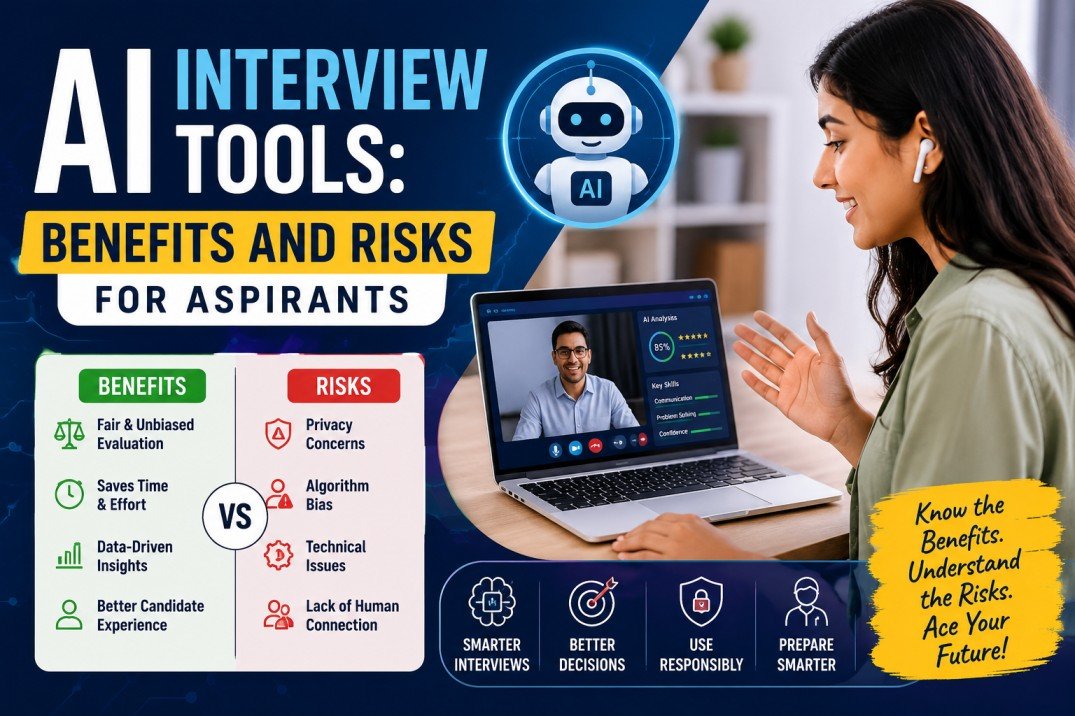
The modern United States job market is undergoing a rapid transformation. AI Interview Tool.Companies now rely on sophisticated software to screen candidates, fundamentally changing how professionals approach their career growth. Achieving Job search success today requires more than just a polished resume; it demands an understanding of the digital gatekeepers managing the hiring process. Many applicants utilize innovative technology to practice their responses and refine their delivery. While these systems offer impressive efficiency, they also introduce complex challenges that every candidate must navigate carefully. Balancing human authenticity with automated expectations is the new standard for landing your dream role. Key Takeaways : AI Interview Tools The Evolution of the Modern Hiring Process Modern recruitment has shifted from human-centric manual labor to a data-driven digital ecosystem. These digital hiring trends have fundamentally altered how companies identify and attract toptier talent in a competitive market. Organizations no longer rely solely on intuition, choosing instead to leverage sophisticated software to manage the influx of applications. The Shift Toward Automated Screening AI Interview Tools In the past, recruiters spent countless hours reviewing paper resumes to find qualified candidates. Today, automated recruitment allows firms to process thousands of applications in mere seconds. This transition is essential for maintaining hiring process efficiency when dealing with high-volume job postings. By utilizing intelligent algorithms, companies can instantly filter candidates based on specific skills, experience, and certifications. This ensures that only the most relevant profiles reach the desk of a human hiring manager. Consequently, the initial stage of the funnel has become almost entirely machine-led. How AI Interview Tools Are Reshaping Recruitment The integration of AI tools has moved beyond simple resume parsing into the realm of behavioral assessment. These platforms analyze candidate responses to predict job performance and cultural fit before a face-to-face meeting occurs. This automated recruitment approach provides a standardized evaluation that reduces human subjectivity. As digital hiring trends continue to evolve, the focus remains on optimizing the candidate experience while maintaining rigorous standards. The following table highlights the core differences between traditional methods and modern, AI-driven workflows. Feature Traditional Hiring AI-Driven Hiring Screening Speed Slow (Manual) Instant (Automated) Candidate Volume Limited Capacity High Scalability Hiring Process Efficiency Low High Evaluation Bias High (Human) Reduced (Algorithmic) Key Benefits of Using AI Interview Tools Modern job seekers are increasingly leveraging AI Interview Tools to gain a competitive edge in a crowded labor market. These platforms provide a structured environment that helps applicants refine their delivery and build lasting confidence. By integrating these resources into your routine, you can significantly improve your overall hiring process efficiency. Improving Candidate Performance Through Mock Interviews Effective interview preparation often requires repetitive practice in a low-stakes environment. AI-driven mock sessions allow you to simulate high-pressure scenarios without the anxiety of a real recruiter watching. You can record your responses, review your body language, and refine your answers until they feel natural and polished. These simulations help you identify nervous habits that might otherwise go unnoticed. By practicing consistently, you transform your delivery from hesitant to authoritative and clear. This level of preparation ensures you walk into your actual interview feeling fully equipped to succeed. Real-Time Feedback and Skill Gap Identification One of the most powerful features of modern AI Interview Tools is the ability to receive instant, data-driven feedback. Instead of waiting days for a recruiter to respond, you get immediate insights into your pacing, tone, and keyword usage. This rapid feedback loop allows you to address specific skill gaps in real time. You can pinpoint exactly where your message loses impact or where your confidence wavers. By focusing on these specific areas, you can sharpen your communication style to better align with what hiring managers are looking for. This targeted approach makes your study time much more productive. Accessibility and Convenience for Remote Aspirants The rise of remote hiring has changed how candidates connect with employers across the United States. AI platforms support this shift by offering a flexible, on-demand experience that fits into any schedule. Whether you are at home or traveling, you can access high-quality coaching tools from any device with an internet connection. This accessibility democratizes the preparation process, ensuring that every candidate has the resources needed to excel. By removing geographical barriers, these tools contribute to greater hiring process efficiency for both the applicant and the organization. Embracing this technology is a smart move for any professional looking to advance their career in a digital-first world. Understanding the Mechanics of AI Assessment Platforms Decoding the complex technology behind modern hiring reveals how your responses are truly measured by digital systems. These platforms utilize sophisticated algorithms to standardize the evaluation process across thousands of applicants. By leveraging AI Interview Tools, companies aim to remove human subjectivity from the initial screening phase. Natural Language Processing in Behavioral Analysis At the core of these systems lies Natural Language Processing, or NLP. This technology parses your spoken words to identify patterns, keywords, and the overall structure of your answers. It is primarily used for behavioral analysis to determine if your past experiences align with the core competencies required for the role. The software looks for specific indicators of problem-solving, leadership, and adaptability. By comparing your vocabulary against high-performing employee profiles, the system assigns a score to your communication style. Precision and clarity are vital when interacting with these language models. Facial Expression and Micro-Gesture Recognition Beyond the words you speak, computer vision tracks your non-verbal cues throughout the session. The platform monitors your eye contact, head movements, and facial expressions to gauge your engagement levels. These micro-gestures provide the software with data points regarding your confidence and honesty. While this might feel intrusive, the goal is to quantify traits like enthusiasm and composure. Consistent eye contact and a neutral, professional posture help the algorithm interpret your body language positively. The system essentially maps your facial landmarks to detect subtle shifts in mood or focus. … Read more