
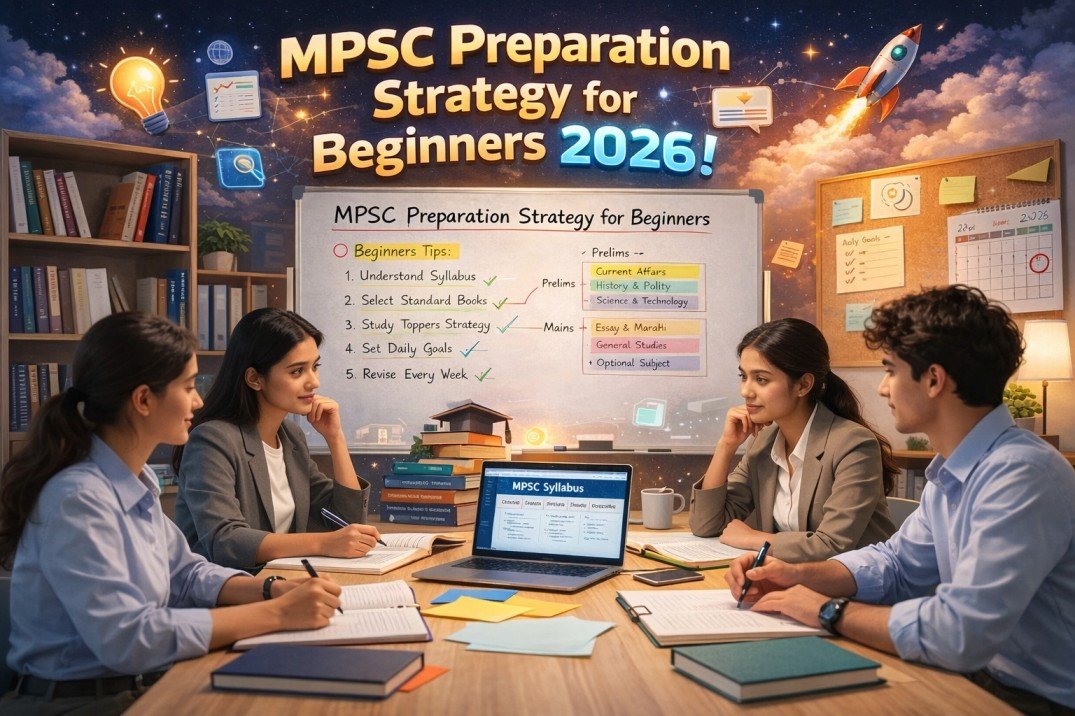
Starting a new journey feels exciting yet a bit overwhelming at times. You might wonder how to tackle this massive syllabus effectively. Having a solid plan is your first step toward reaching real success.
Understanding the exam format helps you focus on what truly matters. It allows you to build a strong foundation without wasting precious time on irrelevant topics. A structured approach ensures you stay consistent every single day.
A clear path makes the entire process enjoyable and very manageable for everyone. Let us dive into this beginner’s guide to MPSC to kickstart your journey today. You have the potential to achieve something truly great.
With the right mindset, your MPSC 2026 preparation will lead you to incredible heights. Stay motivated and keep your eyes on the ultimate prize. Your dedication will surely pay off in the end.
Key Takeaways
- Grasp the exam structure early to guide your daily study efforts.
- Establish a consistent routine to build long-term mental stamina.
- Select high-quality resources to simplify your learning process.
- Focus on basic concepts before tackling any complex subject matter.
- Use regular practice tests to identify your specific strengths and weaknesses.
- Keep a positive mindset to overcome any initial study hurdles.
Understanding the MPSC Examination Structure
Understanding the MPSC exam structure is vital for effective preparation. The Maharashtra Public Service Commission (MPSC) conducts various exams to recruit candidates for different government positions in Maharashtra.
What is MPSC and Why It Matters for Your Career
The MPSC is a state-level organization responsible for conducting competitive exams to fill various government vacancies. Clearing the MPSC exam can open doors to prestigious government jobs, offering job security, social respect, and a chance to serve the community.
Career Opportunities: The MPSC exam provides opportunities to work in various departments of the Maharashtra government, including administrative, technical, and other fields.
Three Main Stages: Prelims, Mains, and Interview Explained
The MPSC exam process typically consists of three stages: Preliminary Examination (Prelims), Main Examination (Mains), and a Personal Interview.
- Prelims: This is the first stage, which is a screening test. It consists of multiple-choice questions that test a candidate’s knowledge in various subjects.
- Mains: Candidates who clear the Prelims are eligible for the Mains exam. This stage is more comprehensive and tests the candidate’s in-depth knowledge and understanding.
- Interview: The final stage is a personal interview, which assesses the candidate’s personality, communication skills, and suitability for the role.
Popular Positions You Can Aim For Through MPSC
The MPSC exam offers a range of career opportunities in various fields. Some of the popular positions include:
| Position | Description |
| Deputy Collector | A key administrative role involving policy implementation and management. |
| Assistant Commissioner | Involves administrative and revenue-related tasks. |
| Sales Tax Inspector | Responsible for ensuring compliance with tax laws. |
These roles not only offer a stable career but also the chance to make a meaningful impact on society.
Eligibility Criteria and Important Dates for 2026
Understanding the eligibility criteria for MPSC 2026 is crucial for aspiring candidates. The Maharashtra Public Service Commission (MPSC) exam has specific requirements that candidates must fulfill to be eligible for the examination.
Educational Qualifications You Need to Meet
Candidates must possess a bachelor’s degree from a recognized university or institution to be eligible for the MPSC exam. The degree can be in any discipline, but it’s essential to check the specific requirements for the desired post, as some positions may require specialized qualifications.
For instance, for certain technical or professional posts, candidates may need to have a degree in a relevant field such as engineering, medicine, or law.
| Post | Required Educational Qualification |
| Administrative Officer | Bachelor’s degree in any discipline |
| Technical Officer | Bachelor’s degree in relevant engineering discipline |
| Medical Officer | MBBS degree |
Age Limits and Category-Wise Relaxations
The MPSC exam has specific age limits for MPSC that candidates must adhere to. Generally, the minimum age limit is 18 years, and the maximum age limit varies depending on the category and the specific post applied for.
Category-wise relaxations are provided as per government norms. For example, candidates from reserved categories such as SC/ST/OBC may get relaxations in the upper age limit.
- General Category: 18-38 years
- SC/ST Category: 18-43 years
- OBC Category: 18-41 years
Critical MPSC 2026 Exam Dates to Remember
Aspirants should be aware of the MPSC exam dates 2026 to plan their preparation accordingly. While the exact dates for 2026 are subject to change, candidates can refer to the previous year’s exam schedule for a rough idea.
The MPSC exam typically consists of three stages: Prelims, Mains, and Interview. Candidates should mark their calendars for these critical dates and start preparing well in advance.
Complete MPSC Preparation Strategy for Beginners 2026
To achieve success in the MPSC exam, beginners need a robust preparation strategy tailored to their needs. This involves understanding the exam’s structure, creating a study plan, and staying committed to their goals.
Building Your Personalized Study Roadmap from Scratch
Creating a study roadmap is the first step towards a successful MPSC preparation journey. It involves identifying the syllabus, gathering resources, and allocating time to each subject based on its weightage and your proficiency.
- Identify the MPSC syllabus and exam pattern
- Gather relevant study materials and resources
- Create a timeline with milestones for each subject
Setting Achievable Goals and Monthly Milestones
Setting clear, achievable goals is crucial for maintaining motivation and tracking progress. Break down your study plan into monthly milestones to stay focused.
Key aspects to consider:
- Define your short-term and long-term goals
- Allocate specific topics to each month
- Regularly review and adjust your goals as needed
How to Balance MPSC Preparation with Work or College
Balancing MPSC preparation with other responsibilities requires effective time management. Create a schedule that accommodates your study time, work, or college commitments.
Tips for balancing:
- Prioritize your tasks and manage your time efficiently
- Use commute or break times for studying
- Stay consistent and avoid procrastination
Deciding Between Self-Study and Coaching Classes
Choosing between self-study and coaching classes depends on your learning style, discipline, and resources. Both methods have their advantages and can be effective when used correctly.
Consider the following:
- Self-study offers flexibility and personalization
- Coaching classes provide structured guidance and support
- Combine both methods for a balanced approach
Selecting the Right Study Materials and Resources
MPSC aspirants often find it challenging to identify the best study materials for their preparation. With a plethora of resources available, it can be overwhelming to decide what to study from.
Must-Have Books for MPSC Prelims and Mains
For MPSC Prelims and Mains, having the right books is crucial. Some of the must-have books include:
- Indian Polity by M. Laxmikanth
- History of Modern India by Bipan Chandra
- Indian Economy by Ramesh Singh
These books cover the syllabus comprehensively and are highly recommended by toppers.
Best Online Platforms and Apps for MPSC Preparation
In addition to books, online platforms and apps can significantly aid MPSC preparation. Some popular options include:
- MPSC Online Test Series
- Unacademy MPSC Courses
- BYJU’S MPSC Study Material
These platforms offer a range of study materials, including video lectures and practice tests.
Essential Newspapers and Magazines for Daily Reading
Staying updated with current affairs is vital for MPSC. Reading the right newspapers and magazines can help. Some essential reads include:
- The Hindu
- Indian Express
- Yojana Magazine
These sources provide comprehensive coverage of national and international news.
Free vs. Paid Resources: Making Smart Choices
Aspirants often debate between free and paid resources. Here’s a comparison:
| Resource Type | Cost | Quality |
| Free Online Resources | No cost | Varies |
| Paid Online Courses | Moderate to High | High |
| Coaching Classes | High | High |
It’s essential to weigh the pros and cons based on your budget and study needs.
Subject-Wise Preparation Strategies That Work
Understanding the subject-wise preparation strategies is crucial for MPSC aspirants to achieve success in the exam. A focused approach across various subjects can significantly enhance a candidate’s chances of clearing the MPSC exam.
History and Indian Culture Preparation
History and Indian Culture is a significant component of the MPSC syllabus. Aspirants should focus on Ancient, Medieval, and Modern Indian History, as well as Maharashtra History and Cultural Heritage.
Ancient, Medieval, and Modern Indian History Focus
To prepare for Indian History, start by understanding the major events and periods. Focus on the ancient civilizations, medieval dynasties, and modern historical events that shaped India.
- Ancient India: Indus Valley Civilization, Vedic Period
- Medieval India: Delhi Sultanate, Mughal Empire
- Modern India: British Rule, Freedom Struggle
Maharashtra History and Cultural Heritage
Maharashtra’s history and cultural heritage are vital for MPSC aspirants. Study the Maratha Empire, significant historical figures like Shivaji Maharaj, and the cultural practices of Maharashtra.
Geography and Environment Studies
Geography and Environment Studies are critical subjects that require a comprehensive understanding of Maharashtra Geography: Physical and Economic aspects and Environmental Issues and Conservation efforts.
Maharashtra Geography: Physical and Economic
Focus on the physical features of Maharashtra, including its topography, climate, and natural resources. Understand the economic geography, including agriculture, industries, and transport networks.
Environmental Issues and Conservation
Study environmental issues such as pollution, deforestation, and climate change. Learn about conservation efforts and initiatives in Maharashtra.
Polity and Governance Mastery
Polity and Governance are crucial subjects that involve understanding the Indian Constitution and Political System and Maharashtra State Administration.
Indian Constitution and Political System
Gain a deep understanding of the Indian Constitution, including its preamble, fundamental rights, and directive principles. Study the structure and functions of the government.
Maharashtra State Administration
Learn about the administrative structure of Maharashtra, including the roles of the Governor, Chief Minister, and various government departments.
Economics and Social Development
Understanding economics and social development is essential for MPSC aspirants. Focus on key concepts and issues related to economic development, poverty, and social welfare schemes in India and Maharashtra.
General Science and Technology Basics
General Science and Technology is a broad subject that covers physics, chemistry, biology, and technology. Focus on basic concepts and recent developments in these areas.
Mastering Current Affairs for MPSC 2026
Staying updated with current affairs is a crucial aspect of MPSC preparation, requiring a strategic approach to daily news consumption and note-making. Current affairs not only constitute a significant portion of the MPSC syllabus but also play a vital role in enhancing your understanding of static subjects.
Building a Daily Current Affairs Reading Habit
Developing a daily habit of reading current affairs is essential for MPSC aspirants. This involves:
- Reading newspapers like The Hindu or Indian Express daily
- Following reliable news websites and apps
- Utilizing monthly current affairs magazines
Consistency is key; allocate a specific time each day for current affairs reading to make it a habit.
Making Concise and Effective Current Affairs Notes
Making notes is an art that can significantly enhance your current affairs preparation. Tips for effective note-making include:
- Focus on key events and their implications
- Organize notes by topic or month for easy revision
- Use headings, subheadings, and bullet points for clarity
As “Notes are the backbone of revision”, making concise and effective notes can greatly aid in your MPSC preparation.
“The key to success in MPSC exams lies in staying updated with current affairs and integrating them effectively into your study plan.”
Focusing on Maharashtra-Specific Developments
For MPSC, it’s not just about national or international news; Maharashtra-specific developments are equally important. Focus on:
| Category | Examples |
| Government Schemes | Programs launched by the Maharashtra government |
| Economic Developments | Investments, infrastructure projects in Maharashtra |
| Social Issues | Issues related to education, health, and social welfare in Maharashtra |
Connecting Current Affairs with Static Subjects
One of the most effective ways to enhance your MPSC preparation is by connecting current affairs to static subjects. For example:
- Linking environmental current affairs to ecology and environment topics
- Relating political developments to polity and governance
By integrating current affairs with static subjects, you not only enhance your understanding but also improve your ability to retain information.
Time Management and Study Schedule Planning
A well-planned study schedule is the backbone of successful MPSC preparation. To crack the exam, aspirants need to manage their time effectively, balancing multiple subjects and topics.
Creating a Realistic Daily Study Timetable
To start, it’s essential to create a realistic daily study timetable that fits your lifestyle. Begin by assessing your daily routine and identifying time slots that you can dedicate to studying. Consider your energy levels and focus during different parts of the day to maximize your productivity.
For instance, if you’re more alert in the morning, allocate challenging subjects like History and Indian Culture during this time. Less demanding tasks, such as revising notes, can be done during the afternoon when energy levels might dip.
Allocating Time to Each Subject Based on Weightage
Understanding the weightage of each subject in the MPSC exam is crucial for effective time allocation. Subjects with higher weightage, such as General Studies, should be given more time compared to those with lower weightage.
A good strategy is to allocate time based on the marks allocated to each subject in the exam syllabus. This ensures that you’re focusing more on high-scoring areas.
Identifying Your Most Productive Study Hours
Everyone has a unique productivity peak during the day. Some people are more focused in the morning, while others might be more productive late at night. It’s essential to identify your most productive hours and schedule your most challenging study sessions during this time.
Experiment with different study times to determine when you’re most focused. Once you’ve identified your peak productivity hours, make the most of them by tackling complex topics or subjects that require intense concentration.
Taking Smart Breaks to Avoid Burnout
Studying for long hours without breaks can lead to burnout, negatively impacting your productivity and retention. Incorporating smart breaks into your study schedule can help maintain your mental and physical well-being.
Techniques like the Pomodoro Technique, which involves studying for 25 minutes followed by a 5-minute break, can be highly effective. During breaks, engage in activities that relax your mind, such as taking a short walk or meditating.
Developing Strong Answer Writing Skills
To excel in the MPSC examination, developing robust answer writing skills is essential. The ability to articulate thoughts clearly and concisely can significantly impact your overall score. It’s not just about knowing the facts, but also about presenting them in a structured and coherent manner.
Understanding What MPSC Examiners Expect
MPSC examiners look for answers that are not only informative but also well-organized and easy to understand. As noted by toppers, “Understanding the expectations of the examiner is key to scoring well in the MPSC exam.” To meet these expectations, it’s crucial to understand the marking scheme and the type of questions asked.
The examiners are looking for candidates who can analyze information, think critically, and present their thoughts in a clear and concise manner. This requires a deep understanding of the subject matter and the ability to apply that knowledge effectively.
Structuring Answers with Introduction, Body, and Conclusion
A well-structured answer typically consists of an introduction, body, and conclusion. The introduction should provide a brief overview of the topic, the body should contain the main content, and the conclusion should summarize the key points.
Using a clear and logical structure helps in presenting your answers in a coherent and easy-to-follow manner. For instance, when answering a question on a historical event, you could start by introducing the event, followed by its causes and consequences, and conclude by highlighting its significance.
Using Diagrams, Flowcharts, and Bullet Points Effectively
Visual aids like diagrams, flowcharts, and bullet points can enhance the clarity and presentation of your answers. They help in organizing complex information into easily digestible formats.
For example, when explaining a process or a system, a flowchart can be particularly useful. Similarly, bullet points can be used to list down key features or advantages of a particular concept or policy.
“The use of diagrams and flowcharts can significantly improve the readability and impact of your answers.”
Daily Answer Writing Practice Techniques
Regular practice is essential for improving answer writing skills. Setting aside time each day to practice writing answers to sample questions can help in developing your writing style and speed.
Some effective techniques include:
- Writing answers within a set time limit to simulate exam conditions.
- Reviewing and analyzing your answers to identify areas for improvement.
- Seeking feedback from mentors or peers on your answer writing style.
By incorporating these practices into your daily routine, you can significantly enhance your answer writing skills and improve your performance in the MPSC exam.
Mock Tests and Self-Assessment Strategies
As you progress in your MPSC preparation journey, incorporating mock tests and self-assessment strategies becomes crucial for success. Mock tests are a simulation of the actual exam experience, helping you gauge your preparation level, identify weak areas, and fine-tune your exam strategy.
When and How to Start Taking Mock Tests
It’s advisable to start taking MPSC mock tests after you have covered a significant portion of the syllabus. Initially, you can take them at wider intervals, gradually increasing the frequency as the exam date approaches. This helps in getting accustomed to the exam pattern and time management.
Begin with subject-wise mock tests to assess your understanding of individual topics. As you progress, move on to full-length mock tests to simulate the actual exam experience. This progressive approach helps in building endurance and improving your overall performance.
Analyzing Your Performance to Identify Weak Areas
After taking a mock test, it’s crucial to analyze your performance thoroughly. Identify the topics or sections where you struggled the most. This analysis will help you understand your strengths and weaknesses, allowing you to focus your study efforts more effectively.
Maintain a record of your mock test scores and track your progress over time. This will not only help in identifying areas that need improvement but also in boosting your confidence as you see your scores improve.
Learning from Your Mistakes and Improving
Learning from your mistakes is a critical aspect of MPSC preparation. When you identify a question or topic you got wrong, make sure to revisit the concept and understand where you went wrong. This iterative learning process is key to improving your performance.
Create a mistake log to keep track of the errors you make during mock tests. Reviewing this log regularly will help you avoid making the same mistakes in the future.
Simulating Real Exam Conditions at Home
To get the most out of mock tests, it’s essential to simulate real exam conditions at home. Take the mock test at the same time as the actual exam, and adhere to the same rules and time limits. This helps in building your endurance and getting comfortable with the exam environment.
Create a dedicated study space that is quiet and free from distractions. This will help you stay focused during your mock tests and actual exam.
Effective Revision Techniques Before the Exam
The final stretch before the MPSC exam requires a focused revision plan. As you prepare for the exam, it’s essential to have a strategy that maximizes your retention and recall of the vast syllabus.
Creating Concise Revision Notes and Flashcards
One of the most effective ways to revise is by creating concise notes and flashcards. These tools help in quick recall and are especially useful during the last few days before the exam.
- Identify key concepts and topics that are frequently tested.
- Use bullet points and headings to organize your notes.
- Create flashcards for important dates, events, and formulas.
Last Three Months Revision Strategy
A structured revision plan for the last three months can significantly improve your chances of success. Here’s a suggested approach:
- Month 1: Focus on revising the entire syllabus at a moderate pace.
- Month 2: Intensify your revision by focusing on weak areas and practicing with mock tests.
- Month 3: Concentrate on high-yield topics and refine your revision notes.
Quick Recall Methods and Memory Techniques
Employing effective memory techniques can enhance your ability to recall information during the exam. Some useful methods include:
- Mnemonics: Create acronyms or rhymes to remember key information.
- Association: Link new information to something you already know or find memorable.
- Visualization: Use diagrams and mind maps to visualize complex information.
Prioritizing High-Yield Topics for Final Review
As the exam approaches, it’s crucial to prioritize topics that are more likely to be tested. Analyze previous years’ question papers to identify these high-yield topics and focus your revision accordingly.
Common Mistakes Beginners Make During MPSC Preparation
Embarking on the MPSC preparation journey can be daunting, and beginners often stumble upon common pitfalls. Understanding these mistakes is crucial to avoiding them and ensuring a smooth preparation process.
Collecting Too Many Books and Resources
One of the most common mistakes beginners make is accumulating a vast number of study materials without a clear strategy for utilizing them. This can lead to confusion and inefficiency in their study plan.
Prioritization is key. Instead of buying numerous books, focus on a few trusted sources that comprehensively cover the syllabus.
Neglecting Your Physical and Mental Health
MPSC preparation is a marathon, not a sprint. Neglecting one’s health can lead to burnout, decreased productivity, and poor performance.
Maintaining a healthy lifestyle is essential. Regular exercise, a balanced diet, and adequate sleep can significantly improve focus and overall well-being.
Starting Preparation Without a Clear Strategy
Diving into MPSC preparation without a well-defined plan can lead to ineffective studying and a lack of direction.
Creating a structured study plan that outlines goals, milestones, and timelines is vital for making consistent progress.
Ignoring Previous Years’ Question Papers
Previous years’ question papers are a valuable resource for understanding the exam pattern, difficulty level, and important topics.
Analyzing these papers can help aspirants identify areas to focus on and improve their time management skills.
Procrastinating and Delaying Important Topics
Procrastination is a significant obstacle to effective MPSC preparation. Delaying important topics can lead to a last-minute rush, resulting in poor retention and performance.
Breaking down study sessions into manageable chunks and setting achievable daily goals can help overcome procrastination.
Conclusion
Embarking on the MPSC preparation journey requires dedication, persistence, and a well-structured strategy. By understanding the examination structure, setting achievable goals, and selecting the right study materials, beginners can lay a strong foundation for success.
As you move forward, mastering current affairs, developing strong answer writing skills, and practicing with mock tests will significantly enhance your chances of cracking the MPSC 2026 exam. Stay focused, manage your time effectively, and maintain a balanced approach to your preparation.
For a successful MPSC preparation conclusion, it’s essential to stay motivated and adapt to the challenges that come your way. By following the strategies outlined and incorporating final tips for MPSC success, you’ll be well on your way to achieving your goals.
Stay committed to your goals, and with the right mindset and preparation, you can excel in the MPSC 2026 exam.
FAQ
What exactly is the MPSC exam, and why is it a great career choice for 2026?
The Maharashtra Public Service Commission (MPSC) is the state agency responsible for recruiting officers into the Maharashtra government. Choosing this path for 2026 offers you a prestigious career with the opportunity to serve the public in high-ranking roles like Deputy Collector, Deputy Superintendent of Police (DYSP), and Tehsildar. It provides job security, social status, and a platform to implement real change in society.
Can a beginner realistically clear the MPSC 2026 exam through self-study?
Yes, you definitely can! Many toppers have successfully cleared the exam without expensive coaching by utilizing high-quality resources like Mrunal.org, YouTube educational channels, and standard reference books. The secret to success in self-study is maintaining a disciplined daily study timetable, understanding the MPSC syllabus thoroughly, and staying consistent with your personalized roadmap.
Which books are considered essential for a solid MPSC preparation foundation?
To build a strong base, start with Maharashtra State Board textbooks from Class 6 to 12. For core subjects, professional aspirants rely on M. Laxmikanth for Indian Polity, Ranjan Kolambe or Nitin Singhania for Economics, and Bipan Chandra for Modern History. Using these standard materials ensures you are aligned with the actual exam standards.
How should I approach Current Affairs for the Maharashtra region?
Staying updated is crucial! We recommend reading a reputable English daily like The Hindu or The Indian Express for national news. For Maharashtra-specific developments, newspapers like Lokmat or Maharashtra Times are indispensable. Additionally, following the Press Information Bureau (PIB) and monthly magazines like Chalu Ghadamodi will keep you ahead of the curve.
What are the eligibility criteria for the MPSC 2026 examination?
To be eligible, you must hold a Bachelor’s degree from a recognized university; even students in their final year can apply for the Prelims. The minimum age is typically 19 years, while the upper age limit for the general category is 38 years, with specific category-wise relaxations for OBC, SC, ST, and PWD candidates as per government regulations.
How important are Previous Year Question Papers (PYQs) in the preparation process?
They are your most valuable tool! Analyzing Previous Year Question Papers helps you understand the exam pattern, the weightage of different subjects, and the specific types of questions the commission prefers. It prevents you from wasting time on irrelevant topics and helps you focus on high-yield areas.
How can I improve my answer writing skills for the MPSC Mains?
A: Answer writing is an art that improves with daily practice. Focus on structuring your responses with a clear introduction, body, and conclusion. Use bullet points, flowcharts, and diagrams to make your answers visually appealing to the examiner. Regularly practicing with mock tests and getting feedback is the best way to refine your technique before the 2026 exam.
What is the best way to balance MPSC preparation with a full-time job?
It’s all about smart time management. Aim for at least 3 to 4 hours of focused study on workdays and scale up to 8 to 10 hours on weekends. Utilize your commute to listen to podcasts or read e-newsletters. Prioritize quality over quantity, and ensure you use your most productive hours for the most challenging subjects.
When should I start taking mock tests for the 2026 cycle?
You should start taking subject-wise mock tests once you have covered at least 50% of the syllabus. Full-length preliminary mocks should ideally begin 3 to 4 months before the exam date. This helps in simulating real exam conditions, improving your speed, and identifying your weak areas early enough to fix them.
Read Also : Top 10 courses in 2026 that can help you get your first job faster