
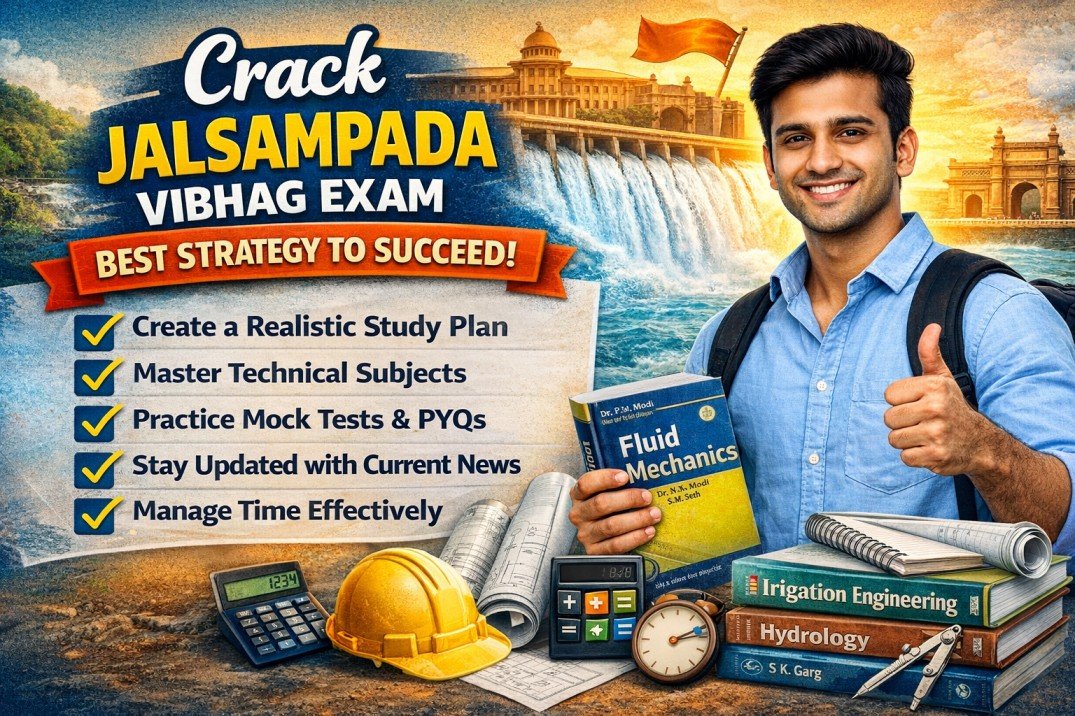
Securing a position in the water resources department requires a disciplined plan and steady focus. This guide provides an essential path to help you pass the Jalsampada Vibhag Exam Strategy 2026 . We want to make your journey easy with clear and friendly advice to boost your morale.
Cracking a competitive Maharashtra government exam might feel difficult at first. However, using the right exam preparation tips builds your confidence and keeps you moving forward. We will show you how to manage your time and learn the full syllabus well.
By following these steps, you will be ready for the big test in 2026. Staying organized is the main secret to winning your career goal. You have the talent, and now you just need a better strategy to shine during the selection process.
Many students feel overwhelmed by the vast amount of information required. Our goal is to simplify the learning process so you can focus on what matters. With the right mindset, your dream job is well within your reach.
Key Takeaways : Jalsampada Vibhag Exam Strategy 2026
- Build a study schedule to cover all topics effectively.
- Review the syllabus to find your strongest and weakest areas.
- Use previous test papers to practice your timing.
- Keep up with current news and local events daily.
- Choose high-quality study materials for better results.
- Take regular breaks to keep your mind fresh and focused.
Understanding the Jalsampada Vibhag Exam Pattern and Syllabus
A successful Jalsampada Vibhag exam strategy hinges on a thorough comprehension of the exam’s structure and content. The Maharashtra government’s official notification is the primary source of information for understanding the exam pattern and syllabus.
Decoding the Official Notification : Jalsampada Vibhag Exam Strategy 2026
The official notification released by the Maharashtra government is a treasure trove of information. It contains details about the exam pattern, syllabus, and subject weightage. Carefully reading and understanding this notification is crucial for any aspiring candidate.
The notification will typically outline the exam format, including the types of questions, duration, and marking scheme. It will also provide insights into the syllabus, highlighting the topics and subjects that will be covered in the exam.
Breakdown of Subject Weightage : Jalsampada Vibhag Exam Strategy 2026
Understanding the subject weightage is vital for allocating study time effectively. The official notification or the exam’s previous year’s pattern can give insights into which subjects carry more weight.
- Technical Subjects: These might include topics related to water resources engineering, irrigation, and other relevant technical areas.
- Non-Technical Subjects: General knowledge, Marathi, English, and quantitative aptitude are common non-technical subjects.
Identifying High-Yield Topics : Jalsampada Vibhag Exam Strategy 2026
Not all topics within the syllabus are equally important. Identifying high-yield topics can help focus your study efforts. Previous year’s question papers and expert analysis can be invaluable resources for this purpose.
Some key areas to focus on might include:
- Fluid mechanics and hydraulics
- Irrigation engineering principles
- Hydrology and water management concepts
Developing a Comprehensive Jalsampada vibhag exam strategy for maharashtra government 2026
The key to acing the Jalsampada vibhag exam lies in developing a robust and flexible study plan. A well-structured study strategy enables candidates to manage their time effectively, cover the vast syllabus, and stay motivated throughout their preparation journey.
Setting Realistic Daily Study Goals
Setting achievable daily study goals is the foundation of a successful study plan. Candidates should assess their strengths, weaknesses, and available study time to create a realistic schedule. It’s essential to prioritize topics based on their weightage and difficulty level.
For instance, a candidate can allocate specific times for studying technical subjects like water resources engineering and irrigation engineering, while also dedicating time to non-technical subjects like Marathi and English language skills.
Balancing Technical and Non-Technical Subjects
A balanced approach to studying both technical and non-technical subjects is vital for success in the Jalsampada vibhag exam. Candidates should allocate their study time wisely, ensuring that they cover all necessary topics.
The following table illustrates a sample study plan that balances technical and non-technical subjects:
| Day | Technical Subjects | Non-Technical Subjects |
| Monday | Fluid Mechanics and Hydraulics (3 hours) | Marathi Language Skills (1.5 hours) |
| Tuesday | Irrigation Engineering (3 hours) | English Language Skills (1.5 hours) |
| Wednesday | Hydrology and Water Management (3 hours) | General Knowledge and Current Affairs (1.5 hours) |
Creating a Long-Term Revision Schedule
A long-term revision schedule is crucial for reinforcing learned concepts and ensuring that candidates retain information over time. Candidates should create a revision plan that spans several weeks or months, depending on their available study time.
This plan should include regular revision sessions, practice tests, and assessments to track progress and identify areas for improvement.
Essential Study Resources and Recommended Books
The key to success in the Jalsampada vibhag exam lies in selecting the right study resources and books. Having a comprehensive understanding of the required study materials is crucial for effective preparation.
Selecting Standard Textbooks for Engineering Subjects
For engineering subjects, standard textbooks are indispensable. Some of the highly recommended textbooks include:
- Fluid Mechanics by Streeter and Wylie
- Hydrology and Water Resources Engineering by Subramanya
- Irrigation Engineering by Garg
These textbooks provide in-depth knowledge and cover a wide range of topics relevant to the exam.
Utilizing Maharashtra State Board Materials
Utilizing study materials provided by the Maharashtra State Board can be highly beneficial. These materials are tailored to the state’s syllabus and exam pattern.
“Using state-specific study materials can significantly enhance a candidate’s preparation by aligning their studies with the exam’s specific requirements.”
Maharashtra State Board materials include syllabus guides, previous year question papers, and other relevant study aids.
Leveraging Online Platforms and Digital Tools
In addition to traditional textbooks, online platforms and digital tools can greatly aid preparation. Some recommended resources include:
| Resource | Description |
| Online Courses | Websites like Coursera and edX offer courses relevant to water resources engineering. |
| Study Forums | Participating in forums like Quora and Reddit can help clarify doubts and provide additional study materials. |
| Mobile Apps | Apps like Gradeup and Testbook offer practice tests and study materials. |
By combining standard textbooks, state-specific materials, and digital tools, aspirants can create a robust study plan that covers all necessary topics and enhances their chances of success in the Jalsampada vibhag exam.
Mastering Technical Subjects for Water Resources Engineering
To excel in the Jalsampada vibhag exam, mastering technical subjects related to water resources engineering is crucial. This involves gaining a deep understanding of various technical disciplines that form the backbone of water resource management and engineering.
Read Also : Best Nagar Parishad exam crack strategy in Maharahstra State
The technical subjects not only test your knowledge but also your ability to apply concepts to real-world problems. Therefore, it’s essential to focus on key areas such as fluid mechanics, irrigation engineering, and hydrology.
Focusing on Fluid Mechanics and Hydraulics
Fluid mechanics and hydraulics are fundamental to understanding the behavior of water in various engineering applications. To master these subjects, start by grasping the basic principles of fluid properties, fluid statics, and fluid dynamics.
Key topics to focus on include: Jalsampada Vibhag Exam Strategy 2026
- Bernoulli’s equation and its applications
- Flow measurement techniques
- Pipe flow and channel flow
- Hydraulic machinery such as pumps and turbines
Understanding these concepts will help you tackle problems related to water flow, pressure, and energy transfer in hydraulic systems.
Deep Dive into Irrigation Engineering Principles
Irrigation engineering is another critical area that requires thorough preparation. It involves the planning, design, and management of irrigation systems to ensure efficient water use in agriculture.
Important topics in irrigation engineering include:
- Crop water requirements and irrigation scheduling
- Design of irrigation canals and distribution systems
- Waterlogging and drainage
- Irrigation project planning and management
Mastering these topics will enable you to understand how to optimize water use for agricultural purposes and manage irrigation projects effectively.
Hydrology and Water Management Concepts
Hydrology and water management are vital components of water resources engineering. Hydrology deals with the study of water resources, including precipitation, runoff, and groundwater.
Key concepts to focus on include: Jalsampada Vibhag Exam Strategy 2026
- Hydrologic cycle and water balance
- Rainfall analysis and runoff estimation
- Groundwater flow and aquifer management
- Water resource planning and management strategies
Understanding these concepts will help you analyze and manage water resources sustainably, addressing issues related to water scarcity and flood management.
Strengthening Non-Technical Proficiency
A well-rounded preparation strategy for the Jalsampada vibhag exam includes improving non-technical proficiency. Non-technical subjects, including language skills, general knowledge, and quantitative aptitude, are crucial components of the exam.
Improving Marathi and English Language Skills
To enhance your language skills, focus on reading Marathi and English literature, newspapers, and online content. Regular reading helps in improving comprehension and vocabulary.
Key Strategies: Jalsampada Vibhag Exam Strategy 2026
- Practice comprehension passages
- Enhance vocabulary by learning new words daily
- Improve grammar rules and their application
General Knowledge and Current Affairs Strategy
Staying updated with current affairs is vital. Follow reputable news sources and monthly current affairs magazines to stay informed.
Effective Tips:
- Subscribe to news apps or websites
- Regularly review monthly current affairs summaries
- Participate in online quizzes to test your knowledge
Quantitative Aptitude and Logical Reasoning Tips
Quantitative aptitude and logical reasoning require consistent practice. Start with basic concepts and gradually move to complex problems.
Practicing Effectively: Jalsampada Vibhag Exam Strategy 2026
- Begin with simple problems and increase the difficulty level
- Use online resources and practice tests
- Analyze your mistakes to improve
Effective Mock Test and Previous Year Paper Analysis
A well-crafted strategy for mock tests and previous year paper analysis is essential for success in the Jalsampada vibhag exam 2026. This approach not only helps in understanding the exam pattern but also in identifying areas that require improvement.
Simulating Real Exam Conditions
To get the most out of mock tests, it’s crucial to simulate real exam conditions. This includes setting a timer, sitting in a quiet environment, and avoiding breaks until the test is completed. By doing so, candidates can assess their ability to manage stress and complete the exam within the given timeframe.
Benefits of Simulating Real Exam Conditions:
- Improved time management
- Enhanced focus and concentration
- Better endurance during the actual exam
Identifying Weak Areas Through Performance Metrics
After completing a mock test, it’s essential to analyze the performance metrics to identify weak areas. This involves reviewing the questions answered incorrectly, understanding the concepts behind them, and making a note to revise those topics.
| Performance Metric | Action Required |
| Low score in a particular subject | Focus on revising that subject |
| Consistent mistakes in a specific topic | Practice more questions from that topic |
| Time taken to complete the test | Practice time management techniques |
Learning Time Management Techniques
Effective time management is critical for success in the Jalsampada vibhag exam. By analyzing the time taken to complete mock tests and previous year papers, candidates can identify areas where they need to improve their speed.
Tips for Improving Time Management: Jalsampada Vibhag Exam Strategy 2026
- Practice with a timer to simulate the actual exam experience
- Allocate specific time slots for each section
- Avoid spending too much time on a single question
Maintaining Mental Well-being and Consistency
A healthy mind is the backbone of a successful Jalsampada Vibhag exam preparation strategy. The intense preparation required for this exam can take a toll on a candidate’s mental health, making it essential to adopt practices that promote mental well-being and consistency.
To achieve this balance, it’s crucial to address three key areas: overcoming exam anxiety and stress, understanding the importance of physical health and sleep, and finding ways to stay motivated throughout the preparation period.
Overcoming Exam Anxiety and Stress
Exam anxiety is a common phenomenon that can significantly impact performance. To manage this anxiety, candidates can practice relaxation techniques such as deep breathing exercises and meditation. Regular physical activity is also known to reduce stress levels and improve overall mental health.
Additionally, setting realistic goals and breaking down study material into manageable chunks can help reduce feelings of overwhelm. It’s also beneficial to maintain a positive mindset by focusing on progress rather than perfection.
The Importance of Physical Health and Sleep
Physical health plays a vital role in maintaining mental well-being. Regular exercise not only improves physical fitness but also enhances cognitive function and reduces stress. A balanced diet that includes nutritious foods supports overall health and energy levels.
Adequate sleep is equally important. Lack of sleep can impair concentration and memory, making it harder to study effectively. Candidates should aim for 7-8 hours of sleep each night and establish a consistent sleep schedule to help regulate their body’s internal clock.
Staying Motivated During Long Preparation Cycles
Staying motivated over a long period can be challenging. One effective strategy is to celebrate small victories along the way, whether it’s completing a difficult topic or achieving a good score on a mock test.
Connecting with peers who are going through a similar experience can also provide motivation. Joining study groups or online forums can offer support and help candidates stay engaged with their study routine.
By focusing on mental well-being, managing exam anxiety, prioritizing physical health, and maintaining motivation, candidates can create a robust support system that enhances their overall preparation strategy for the Jalsampada Vibhag exam.
Last-Minute Revision and Exam Day Tactics
The final days before the Jalsampada Vibhag exam are vital for consolidating your knowledge. It’s a period where focused revision and strategic planning can significantly impact your performance.
Creating Concise Summary Notes
One of the most effective ways to revise in the last few days is by creating concise summary notes. These notes should capture the essence of your study material, focusing on key concepts and formulas.
To create summary notes, start by identifying the most critical topics and then distill the information into bite-sized chunks. Use bullet points, headings, and bold text to make your notes visually appealing and easy to review.
Final Review Strategies for the Last Week
In the last week before the exam, your review strategy should be intense and focused. Start by revising the topics you’ve already covered, using your summary notes as a quick reference.
Practice with mock tests and previous year’s papers to gauge your preparation level and identify areas that need last-minute brushing up. Here’s a sample plan for the last week’s revision:
| Day | Revision Topic | Practice Material |
| Monday | Fluid Mechanics | Mock Test 1 |
| Tuesday | Irrigation Engineering | Previous Year Paper 2019 |
| Wednesday | Hydrology | Mock Test 2 |
Managing Logistics and Exam Hall Etiquette
On the exam day, it’s not just your knowledge that matters, but also how well you manage your time and behave in the exam hall. Make sure you reach the exam center well before the reporting time.
Here are some exam day tactics to keep in mind:
- Carry all necessary documents and stationery.
- Read the instructions carefully before starting the exam.
- Manage your time effectively, allocating sufficient time for each section.
Staying calm and focused during the exam is crucial. Take deep breaths if you feel anxious, and remember that it’s normal to feel some level of stress.
Conclusion
Cracking the Jalsampada vibhag exam requires a well-structured Maharashtra government exam strategy. By understanding the exam pattern, developing a comprehensive study plan, and utilizing the right resources, you’ll be well-prepared for the 2026 exam.
A focused approach to technical subjects like Water Resources Engineering, combined with strengthening non-technical proficiency, will significantly enhance your chances of success. Regular mock tests, previous year paper analysis, and maintaining mental well-being are also crucial elements of your preparation.
By following the guidelines and tips provided in this article, you’ll be able to create an effective study plan and stay motivated throughout your preparation journey. With dedication and the right strategy, you can achieve your goal of succeeding in the Jalsampada vibhag exam.
FAQ
How can I stay updated on the official Jalsampada Vibhag recruitment notification for 2026?
To ensure you don’t miss any critical updates, frequently visit the official WRD Maharashtra (Water Resources Department) website and the MPSC (Maharashtra Public Service Commission) portal. Additionally, following reliable educational platforms like Testbook or Adda247 can provide you with real-time alerts regarding the official notification, application deadlines, and any changes to the exam pattern.
Which textbooks are recommended for mastering technical subjects like Fluid Mechanics and Irrigation Engineering?
For Civil Engineering fundamentals, standard textbooks such as those by Dr. P.N. Modi and S.K. Garg are highly effective. For the Jalsampada Vibhag exam, it is also vital to supplement these with Maharashtra State Board materials to align with local technical standards and terminology used in Maharashtra Government projects.
Is there negative marking in the Jalsampada Vibhag exam?
Most competitive exams conducted by the Maharashtra Government, including those following the TCS/IBPS pattern, typically include a negative marking scheme. You should check the 2026 official notification carefully to confirm the exact penalty for incorrect answers, as this will significantly influence your exam strategy and how you approach uncertain questions.
How do I effectively prepare for the Marathi and English language sections?
Strengthening your non-technical proficiency requires a focus on grammar and vocabulary. For Marathi, the textbook by M.R. Walimbe is a gold standard among aspirants. For English, practicing with Wren & Martin and reading daily editorials from The Times of India or The Indian Express will help you improve your comprehension and language skills for the Jalsampada Vibhag selection process.
What is the benefit of analyzing Previous Year Question Papers (PYQs)?
Analyzing Previous Year Question Papers is essential for identifying high-yield topics and understanding the weightage of subjects like Hydrology and Quantitative Aptitude. It allows you to simulate real exam conditions, helping you refine your time management techniques and estimate the expected cut-off marks for the 2026 cycle.
How can I balance my preparation if I am focusing on multiple Maharashtra Government exams?
Since the Jalsampada Vibhag exam strategy shares similarities with other MPSC technical exams, focus on the common core subjects first. Use a long-term revision schedule to keep your technical subjects sharp while dedicating specific hours each week to General Knowledge and Current Affairs using resources like Pratiyogita Darpan or Lokmat for local news.
What should I include in my last-minute revision a week before the exam?
Your final week should be dedicated to reviewing concise summary notes and formulas for Fluid Mechanics and Hydraulics. Avoid starting new topics; instead, focus on mock test performance metrics to boost your confidence. Ensure you prioritize physical health and sleep to stay sharp for the exam day tactics required in the hall.