
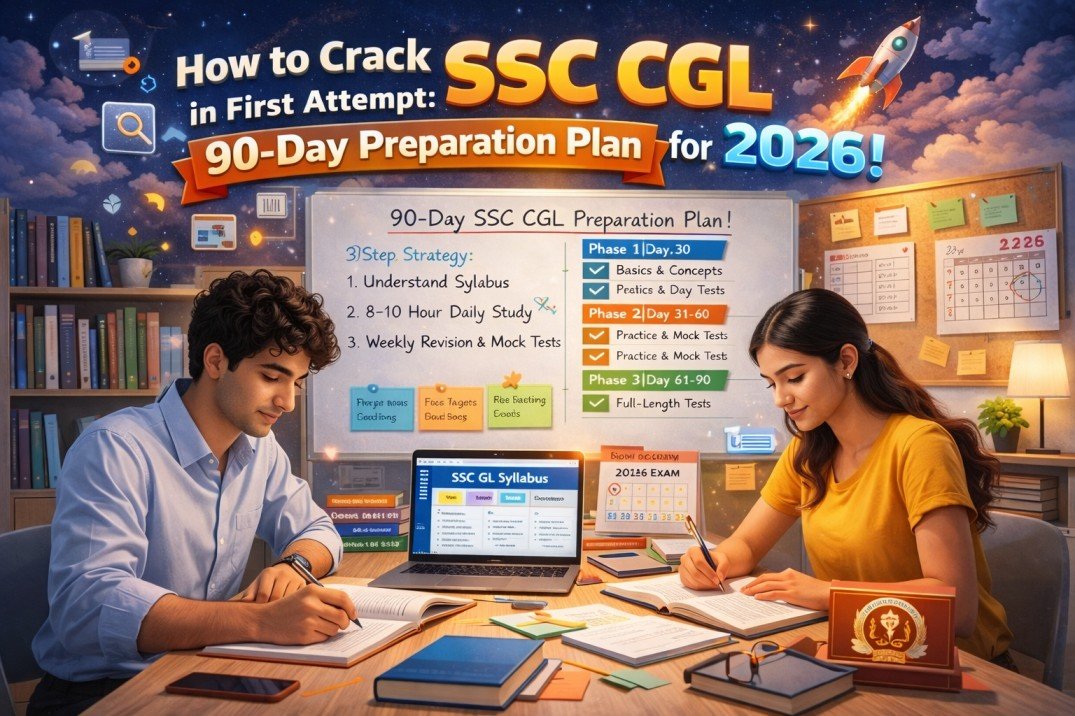
Starting a new career path feels exciting yet challenging for many ambitious candidates seeking professional advancement. Many students dream of passing this competitive government exam on their very start to secure a stable future. A solid strategy makes all the difference when you want proven results in your career today.
Success requires more than just hard work and individual dedication. It demands a structured 90-day study plan covering the entire comprehensive syllabus. Using high-quality exam resources ensures you stay ahead of others during the rigorous selection process.
Focus on consistency and frequent goals reaching your peak performance during these months. You can achieve your goals with the right mindset and necessary tools. This guide provides a clear roadmap for success.
Staying organized helps reduce stress during the learning process significantly. Monitoring progress remains vital while adjusting your schedule regularly based on your needs. Let’s dive into the details.
Key Takeaways : How to crack SSC CGL in first attempt get 90 day plan
- Master the exam pattern and marking scheme early.
- Follow a consistent study routine every week.
- Practice with previous year papers for better speed.
- Focus on weak areas frequently to build confidence.
- Maintain a healthy study-life balance for mental clarity.
- Revise core concepts regularly to ensure long-term memory.
Understanding the SSC CGL Exam Structure
The SSC CGL exam is not just about knowledge; it’s also about understanding its intricate structure. To crack it in the first attempt, one must delve into the details of its various components.
Exam Tiers and Their Importance
The SSC CGL exam is conducted in multiple tiers, each designed to test different aspects of a candidate’s abilities. These tiers are:
- Tier I: Preliminary Examination
- Tier II: Main Examination
- Tier III: Skill Test/ Typing Test
- Tier IV: Document Verification
Each tier has its significance, and understanding the format and content of each is crucial for effective preparation.
Marking Scheme and Time Allocation
The marking scheme and time allocation vary across tiers. For instance, Tier I is a computer-based test with negative marking for incorrect answers, while Tier II has different papers with varying marking schemes.
Key aspects to focus on: How to crack SSC CGL in first attempt get 90 day plan
- Understand the marking scheme for each tier.
- Manage time effectively during the exam.
- Practice with mock tests to get accustomed to the exam pattern.
Eligibility Criteria and Age Limits
Before diving into preparation, it’s essential to check if you meet the eligibility criteria and are within the age limits set by the SSC for the CGL exam.
Eligibility criteria include:
- Educational qualification.
- Age limits, which vary according to the posts.
- Nationality and other requirements.
Why a 90-Day Plan Works for SSC CGL Preparation
Cracking the SSC CGL in the first attempt is a challenging task, but with a well-structured 90-day plan, aspirants can significantly enhance their chances of success. The key to this success lies in understanding the effectiveness of intensive short-term preparation.
The Science Behind Short-Term Intensive Preparation
Short-term intensive preparation, like a 90-day plan, leverages the psychological aspect of focused learning. When candidates dedicate themselves to a rigorous study schedule, they can achieve a high level of concentration and retention.
This approach helps in quick revision and practice, which are crucial for exams like SSC CGL.
Success Stories from First-Time Qualifiers
Many candidates have successfully cracked the SSC CGL in their first attempt using a 90-day plan. Their stories highlight the importance of strategic planning and consistent effort.
For instance, a candidate might focus on weak areas and improve them significantly over the 90 days.
| Candidate | Strategy | Outcome |
| Candidate A | Focused on weak areas | Qualified SSC CGL Tier I |
| Candidate B | Intensive practice | Scored high in Tier II |
| Candidate C | Regular mock tests | Achieved overall success |
Setting Realistic Goals and Expectations
To make the most of a 90-day plan, it’s crucial to set realistic goals. Candidates should assess their current level of preparation and identify areas that need improvement.
By doing so, they can create a tailored study plan that addresses their weaknesses.
How to Crack SSC CGL in First Attempt Get 90 Day Plan: Complete Breakdown
To ace the SSC CGL exam in one attempt, a focused 90-day preparation strategy is essential. This section provides a comprehensive breakdown of how to structure your study plan over 90 days to ensure you’re well-prepared for the exam.
Month 1: Building Strong Foundations (Days 1-30)
The first month is crucial for building a strong foundation. It involves understanding the exam pattern and focusing on basic concepts.
Week 1-2: General Intelligence and Reasoning
During the first two weeks, concentrate on General Intelligence and Reasoning. This includes topics like analogies, coding-decoding, and logical reasoning. Practice these topics regularly to build a strong base.
Week 3-4: Quantitative Aptitude Basics
The next two weeks should focus on Quantitative Aptitude basics. Start with fundamental concepts such as arithmetic, algebra, and geometry. Regular practice will help in improving problem-solving skills.
Month 2: Advanced Concepts and Practice (Days 31-60)
The second month is about delving into advanced concepts and practicing them.
Week 5-6: English Language Mastery
Weeks 5 and 6 should be dedicated to mastering the English Language. Focus on comprehension, grammar, and vocabulary. Reading comprehension passages and practicing grammar exercises will be beneficial.
Week 7-8: General Awareness Deep Dive
During weeks 7 and 8, dive deep into General Awareness. This includes static GK, current affairs, and other relevant topics. Staying updated with current events is crucial.
Month 3: Intensive Revision and Mock Tests (Days 61-90)
The final month is for intensive revision and taking mock tests.
Week 9-10: Full-Length Mock Tests
In weeks 9 and 10, start taking full-length mock tests. This will help in assessing your preparation level and getting accustomed to the exam pattern.
Week 11-12: Targeted Weak Area Improvement
The last two weeks should be used to identify and improve weak areas. Analyze your performance in mock tests and focus on sections that need improvement.
| Month | Weeks | Focus Area |
| 1 | 1-2 | General Intelligence and Reasoning |
| 1 | 3-4 | Quantitative Aptitude Basics |
| 2 | 5-6 | English Language Mastery |
| 2 | 7-8 | General Awareness Deep Dive |
| 3 | 9-10 | Full-Length Mock Tests |
| 3 | 11-12 | Targeted Weak Area Improvement |
Subject-Wise Preparation Strategies
A well-planned subject-wise approach can significantly boost your SSC CGL preparation. The SSC CGL exam is divided into four main subjects: General Intelligence and Reasoning, Quantitative Aptitude, English Language, and General Awareness. Each subject requires a unique preparation strategy to master.
General Intelligence and Reasoning Tactics
General Intelligence and Reasoning is a critical section that tests logical thinking and problem-solving skills. To excel in this section, focus on:
Important Topics to Prioritize
- Analytical Reasoning: Practice puzzles, seating arrangements, and blood relations.
- Logical Reasoning: Focus on statements and conclusions, assumptions, and arguments.
- Non-Verbal Reasoning: Improve your skills in series, analogy, and classification.
Practice Resources and Question Banks
Utilize online resources and question banks that provide a wide range of practice questions. Some recommended resources include:
- SSC CGL previous year papers
- Reasoning ability books by RS Aggarwal
- Online test series on platforms like SSC CGL’s official website or other educational portals
Quantitative Aptitude Mastery Techniques
Quantitative Aptitude is another crucial section that demands a strong grasp of mathematical concepts. To master this section:
Shortcut Methods and Formulas
Learn shortcut methods and formulas to solve problems quickly. Focus on:
- Arithmetic: Practice percentage, profit and loss, and time & work problems.
- Algebra: Understand and apply formulas related to equations and identities.
- Geometry: Familiarize yourself with concepts of lines, angles, and shapes.
Speed Math for Time Management
Practice speed math techniques to save time during the exam. This includes:
- Mental calculations
- Using approximations
- Simplifying complex calculations
English Language Comprehension Approach
The English Language section tests comprehension, vocabulary, and grammar skills. To improve:
Vocabulary Building Strategies
- Read English newspapers and books regularly.
- Use flashcards to learn new words.
- Practice word usage in sentences.
Grammar Rules and Error Detection
Focus on grammar rules and practice error detection exercises. This includes:
- Understanding parts of speech
- Identifying grammatical errors
- Sentence correction exercises
General Awareness and Current Affairs
General Awareness is a broad section that covers static GK and current affairs. To prepare:
Daily News Reading Routine
Develop a habit of reading news daily. Focus on:
- National and international news
- Economic and financial news
- Science and technology updates
Static GK Coverage Plan
For static GK, cover topics such as:
- History: Indian independence movement, major historical events
- Geography: Indian geography, world geography
- Polity: Indian constitution, governance
Essential Study Materials and Resources
The right study materials can make all the difference in your SSC CGL preparation journey. Having a comprehensive and well-curated list of resources is crucial for covering the vast syllabus effectively.
Recommended Books for Each Section
Choosing the right books for SSC CGL preparation is vital. For General Intelligence and Reasoning, “A Modern Approach to Verbal and Non-Verbal Reasoning” by R.S. Aggarwal is highly recommended. For Quantitative Aptitude, “Quantitative Aptitude for Competitive Examinations” by R.S. Aggarwal is a popular choice.
For English Language Comprehension, “Objective General English” by S.P. Bakshi is considered a valuable resource. For General Awareness, “Lucent’s General Knowledge” is widely used by aspirants.
Online Platforms and Mobile Apps
In today’s digital age, online platforms and mobile apps have become indispensable tools for SSC CGL preparation. Platforms like Unacademy and BYJU’s offer comprehensive courses and study materials.
Mobile apps such as Testbook and Gradeup provide mock tests, quizzes, and study materials that can be accessed on the go.
Previous Year Question Papers Importance
Previous year question papers are a treasure trove of information for SSC CGL aspirants. They help in understanding the exam pattern, identifying important topics, and practicing time management.
Solving previous year papers also boosts confidence and gives insight into the types of questions asked in the exam.
Free versus Paid Resources Comparison
While there are many free resources available online, paid resources often offer more structured and comprehensive content. Paid online courses and test series can provide personalized feedback and detailed analysis.
However, it’s essential to strike a balance between free and paid resources based on your budget and study needs.
Time Management and Daily Study Schedule
A 90-day study plan with a focus on time management can significantly enhance your SSC CGL preparation. It’s not just about studying hard, but also about studying smart. Effective time management allows you to cover all necessary topics, practice extensively, and retain information better.
Creating Your Personalized Timetable
To create a personalized timetable, start by assessing your daily routine and identifying the time slots you can dedicate to studying. Consider your most productive hours and schedule your most challenging subjects during this time. Allocate specific times for each subject and stick to it.
For instance, if you’re a morning person, you might want to study subjects like Quantitative Aptitude or General Intelligence and Reasoning during the morning hours when you’re most alert. Use a planner or a mobile app to schedule your study sessions and set reminders.
Sample Study Schedule:
| Time | Monday | Tuesday | Wednesday | Thursday | Friday |
| 8:00-9:00 AM | Quantitative Aptitude | General Intelligence | English Language | General Awareness | Mock Test |
| 9:00-10:00 AM | General Intelligence | English Language | General Awareness | Quantitative Aptitude | Review Weak Areas |
| 10:00-11:00 AM | Break | Break | Break | Break | Break |
| 11:00 AM-12:00 PM | English Language | General Awareness | Quantitative Aptitude | General Intelligence | Practice Previous Papers |
Balancing All Four Sections Effectively
Balancing all four sections of the SSC CGL exam—General Intelligence and Reasoning, General Awareness, Quantitative Aptitude, and English Language—is crucial. Allocate your study time based on your strengths and weaknesses. For example, if you’re weak in Quantitative Aptitude, you might want to dedicate more time to it.
“The key to success is to focus our conscious mind on things we desire not things we fear.” – Brian Tracy
Break Times and Rest Periods
Incorporating break times and rest periods into your study schedule is vital to avoid burnout. Study in focused 60-90 minute increments, followed by a 10-15 minute break. This technique is known as the Pomodoro Technique.
During your breaks, do something relaxing or enjoyable to recharge. This could be taking a short walk, meditating, or reading a book unrelated to your studies.
Adjusting Your Schedule for Working Professionals
For working professionals, adjusting the study schedule to fit around work commitments is essential. You might need to study early in the morning, during your lunch break, or in the evening after work.
Prioritize your tasks, and be flexible with your study plan. If you miss a study session one day, try to catch up on it the next day or adjust your schedule accordingly.
Mock Test Strategy for Maximum Scores
Effective SSC CGL preparation hinges on a robust mock test strategy that identifies strengths, weaknesses, and areas for improvement. A well-structured mock test plan not only assesses knowledge but also enhances exam temperament and time management skills.
When to Start Taking Mock Tests
It’s advisable to start taking SSC CGL mock tests after completing a significant portion of the syllabus. Initially, focus on sectional tests to gauge your understanding of individual subjects. As you progress, shift to full-length mock tests to simulate the actual exam experience.
Analyzing Your Performance Reports
After taking each mock test, thoroughly analyze your performance analysis report. Identify the topics you struggled with and allocate more time to those areas. This targeted approach helps in improving weak spots and reinforcing strong ones.
Converting Mistakes into Learning Opportunities
Mistakes made during mock tests are invaluable learning opportunities. Maintain a record of the errors you make and revisit them regularly. Understanding the concepts behind your mistakes is crucial for avoiding similar pitfalls in the actual exam.
Building Exam Temperament and Speed
Regularly taking mock tests helps in building the right exam temperament and improving your speed. As you become more familiar with the exam pattern and time constraints, you’ll be able to manage your time more effectively and stay calm under pressure.
By incorporating these strategies into your mock test strategy, you’ll be well-prepared to tackle the SSC CGL exam and achieve maximum scores.
Revision Techniques That Actually Work
The key to acing the SSC CGL lies in implementing effective revision techniques. Revision is not just about re-reading your notes; it’s about reinforcing your understanding and retaining the information for the exam. A well-structured revision plan can make a significant difference in your performance.
30-Day Revision Formula
A 30-day revision formula can be a game-changer for SSC CGL aspirants. It involves dedicating the last month before the exam to a focused revision plan. Here’s a simple breakdown:
- Week 1: Revise all subjects, focusing on weak areas.
- Week 2: Practice sectional tests and analyze your performance.
- Week 3: Intensify your revision with full-length mock tests.
- Week 4: Review and refine your knowledge, focusing on high-weightage topics.
This structured approach helps in systematic coverage of the syllabus and improves retention.
Creating Effective Notes and Flashcards
Creating effective notes and flashcards is an art. Notes should be concise, organized, and easily reviewable. Flashcards can be particularly useful for memorizing key terms and concepts.
| Topic | Notes | Flashcard Tips |
| General Intelligence | Summarize key concepts and formulas. | Use one side for the term and the other for the definition. |
| Quantitative Aptitude | Focus on important formulas and shortcut techniques. | Include examples on the flashcard for better understanding. |
Memory Retention Techniques
Memory retention is crucial for recalling information during the exam. Techniques such as spaced repetition, active recall, and mnemonic devices can be highly effective.
“The more you practice recalling information, the more likely you are to remember it during the exam.”
Spaced repetition involves reviewing material at increasingly longer intervals to help solidify it in your long-term memory.
Last-Week Revision Strategy
The last week before the exam is critical. Focus on revising high-weightage topics and practicing mock tests. Avoid learning new concepts and concentrate on reinforcing what you already know.
By following these revision techniques, you can significantly improve your chances of success in the SSC CGL exam. Stay focused, and make the most of your revision time.
Common Mistakes to Avoid During Preparation
To crack the SSC CGL in the first attempt, it’s essential to be aware of the common mistakes that can derail your preparation. Aspirants often get caught up in the vast syllabus and lose focus on the right strategies.
Over-Studying Without Strategic Planning
One of the most significant pitfalls is over-studying without a clear plan. Candidates often get overwhelmed by the vast amount of study material available and end up studying without a focused approach.
To avoid this, create a structured study plan that covers all necessary topics and sticks to it. Prioritize your weak areas and allocate your study time accordingly.
Neglecting Any Single Section
Another critical mistake is neglecting any single section of the SSC CGL exam. Each section, whether it’s General Intelligence and Reasoning, Quantitative Aptitude, English Language, or General Awareness, carries significant weightage.
Ensure you allocate sufficient time to each section and practice consistently. A balanced approach will help you achieve a well-rounded preparation.
Ignoring Physical and Mental Health
Ignoring physical and mental health is a grave mistake. Continuous study sessions without breaks can lead to burnout.
It’s crucial to maintain a healthy lifestyle by taking regular breaks, exercising, and eating a balanced diet. Mental health is equally important; practice stress-relief techniques like meditation or yoga.
Skipping Mock Tests Until the Last Moment
Many candidates make the mistake of delaying mock tests until the last moment. Mock tests are essential for assessing your preparation level and identifying areas for improvement.
Start taking mock tests early in your preparation phase. Analyze your performance, work on your weaknesses, and gradually increase your speed and accuracy.
Conclusion
Achieving SSC CGL success requires dedication, strategic planning, and a well-structured study schedule. The 90-day plan outlined in this article provides a comprehensive roadmap to help aspirants crack the exam in their first attempt.
By following the 90-day plan conclusion, candidates can ensure they cover all necessary topics, practice extensively, and build the confidence needed to excel in the exam. Staying committed to the preparation plan and believing in one’s ability to succeed are crucial.
With the right mindset and a structured approach, SSC CGL aspirants can overcome the challenges of the exam and achieve their goals. The key is to remain focused, manage time effectively, and continually assess and improve one’s performance.
FAQ
Is it genuinely possible to crack the SSC CGL exam in just 90 days on my first attempt?
Yes, it is entirely possible with a disciplined and strategic approach. While the SSC CGL syllabus is vast, a 90-day plan allows you to prioritize high-weightage topics and move from foundational concepts to advanced practice. Many successful candidates who utilize resources like Adda247 or Unacademy have proven that intensive preparation can lead to a top-tier score even for first-timers.
Which specific books are recommended for the Quantitative Aptitude and English sections?
For Quantitative Aptitude, most experts recommend Rakesh Yadav’s Class Notes or Quantum CAT by Sarvesh Verma for those wanting to tackle higher-level questions. For English Language, Neetu Singh’s Plinth to Paramount from KD Publication is essential for grammar, while Word Power Made Easy by Norman Lewis is the go-to resource for building a robust vocabulary.
How should I handle the negative marking in the Tier 1 exam?
Accuracy is your best friend. In Tier 1, there is a negative marking of 0.50 marks for each wrong answer. To mitigate this, you should practice with Testbook or Oliveboard mock tests to develop a “skip strategy.” Learning to identify and skip time-consuming or uncertain questions ensures you don’t lose the marks you’ve already earned.
What is the best way to stay updated for the General Awareness section?
The General Awareness section is divided into static GK and Current Affairs. For static topics, Lucent’s General Knowledge is a classic choice. For daily news, reading The Hindu or following the Press Information Bureau (PIB) updates will keep you informed on the latest government schemes and international events, which are frequently tested by the Staff Selection Commission.
Why is solving Previous Year Papers (PYPs) emphasized so much?
The SSC often follows a specific pattern and frequently repeats concepts. By solving Kiran Publication’s SSC CGL Solved Papers, you get a realistic sense of the difficulty level and the types of questions asked in General Intelligence and Reasoning. It is the most effective way to align your preparation with the actual exam environment.
How can working professionals balance this 90-day plan with a full-time job?
Success for working professionals lies in time management. Aim for at least 3 hours of study on weekdays and 8 to 10 hours on weekends. Utilize digital tools like the BYJU’S Exam Prep app to take short quizzes during breaks or commutes. Focus on Quantitative Aptitude basics during your peak energy hours to ensure you are making the most of your limited time.
When should I start taking full-length mock tests during the 90-day period?
You should start taking sectional mocks as soon as you finish a topic. However, full-length mock tests should become a priority in Month 3. Platforms like PracticeMock provide detailed performance analytics that help you identify if you are lagging in speed or if you need to revisit specific Grammar Rules or Shortcut Methods for math.
What are the common pitfalls I should avoid to ensure a first-attempt success?
One major mistake is over-studying one subject while neglecting others, like General Awareness. Another is delaying mock tests until the very end. Ensure you follow a balanced daily study schedule and prioritize physical health; a burnt-out mind cannot retain complex formulas or vocabulary effectively during the final intensive revision phase.
Read Also : How to crack SSC CGL in first attempt get 90 day plan